


If you invest any funds into the stock market, you are all too aware that 2026 has been a rocky year for the tech sector.
To say the least. As of the publication of this article, the NASDAQ (the tech index of the stock market) is down nearly 3% on the year. And while the DOW did top 50,000, it has dropped nearly 3% since its peak.
This isn’t a financial blog, though. This is an article about a financial blog that has many people uttering the words “Citrini Research” with confusion and awe since the site published its internet-breaking sensation, “The 2028 Global Intelligence Crisis.”
What is Citrini Research? Who is behind the article’s release and the heart-stopping momentum it generated once it was published? Was it simply the work of effective financial forecasting and prediction, or was it a highly effective viral marketing play?
I donned my deerstalker cap, grabbed my digital magnifying glass, and this is what I found.
Citrini Research is a Substack publication that publishes financial insights and original analysis. In their words, they aim to discover and share “market themes & narratives, the ‘megatrends’ affecting not just individual companies or sectors but the entire economy.”
That lofty mission promises to reveal the macroeconomic trends that can shape the stock market, and cite their early discoveries of smash hits like Nvidia, Eli Lily, Eaton, and Credo since they began publishing in 2023.
As a paid subscriber, you can get access to 2-3 “in-depth thematic primers” per year. This includes industry deep dives and exclusive access to their own stock-picking portfolio.

But Citrini Research is the Substack “arm” of the business. There’s much more to this company than initially meets the eye. Citrinitas Capital is a Delaware C-Corp (James still lists it as an LLC on his LinkedIn) founded in 2023, based at 515 Madison Avenue, New York, New York.
There is a website property, also named Citrini Research, which seems to sit between the two; it offers research for institutional investors along with “idea calls” and “custom work,” which are gated behind a login for clients. Aside from several AI-generated photos, the website has little content to parse.
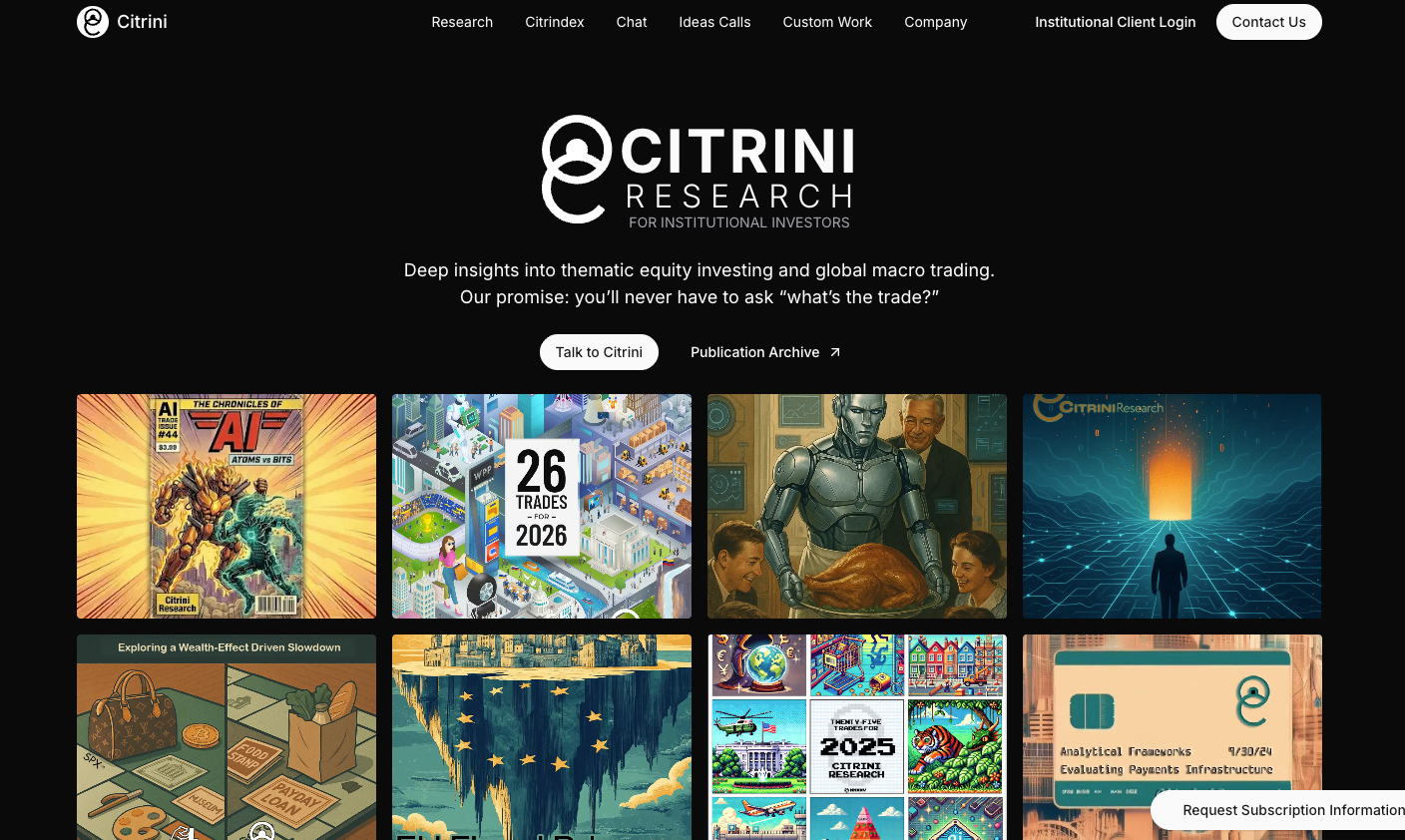
While Cintrinitas Capital was founded in 2023, the only EDGAR filings for the company are in late 2025: one for a $1,000,000 SAFE sold to an investor, and one for a total of $5,050,000 sold to five investors. The identity of the investors is unknown, as this is a privately held company.
In sum, Van Geelen runs a private investment firm/research firm/subscription company that has raised upwards of $6,000,000 from investors and has paid for a Substack publication. Who are these founders, able to apparently raise enviable sums for what amounts to a newsletter?
James Van Geelen graduated from the University of Connecticut in 2013 and attended UCLA Medical School, but did not complete it. While he did not leave medical school with his MD, he began his professional career as an emergency medical technician for nearly 4 years before founding Medify Corporation, which he sold in 2017.
Now, any hard information about this company seems not to have made it to the internet, or to have been scrubbed during the acquisition. There is an old Slideshare with James’ name attached to it on the usage of medicinal cannabis in the treatment of Parkinson’s, but beyond that, not much is known about Van Geelen’s business dealings prior to Citrini.
Nicholas Reece, a Trinity College grad, is the COO of Citrini Research. He previously held roles at Merk Investments, a gold and equities trading firm, as an analyst and VP, then served as a research consultant at Guinness Global Advisors, a fund management firm, and then as an investment Strategist at StoneX Group, a market research firm (somewhat similar, it seems, to Citrini).
So, a healthcare worker and emergency technician, and an economics research professional walk into a bar – and walk out with nearly 200,000 Substack subscribers, private clients for financial research, and $6,000,000 in equity sold.
The report is lengthy, and I’ll admit, fairly well-written. It’s engaging, gripping, and highly shareable – because it was designed to be.
While the article begins by claiming it does not aim to be “bear porn” or “doomer fan fiction,” it seems to be exactly that: it’s a bit of speculative fiction that capitalized on the white-collar worker’s greatest fears while tanking the market.
What’s odd is how something that would fit in far better alongside a Michael Crichton novel has launched itself to the front of the cultural zeitgeist.
But… is it? Or was this the exact time to launch their first free report that anyone can read, whether or not they have a subscription?
You can read it for free here but it is quite long, so for a quick summary, the report states:
If you had asked Claude to come up with an AI Doomsday scenario that would capitalize on the fears of people working in tech – all while inflation remains high, tariffs continue to add to economic uncertainty, layoffs have earned monthly coverage, and each new AI enhancement promises to displace more and more workers – well, I think it would look a bit like the scenario that the research report outlines.
In fact, when I feed that prompt to Claude, it’s eerily similar to the scenario described in the report:
AUSTIN, Texas — The parking garage at Domain Northside, a mixed-use development that once anchored one of Austin's most vibrant tech corridors, has been free to park in since January. The reason is simple: there is no one left to charge.
Of the fourteen SaaS companies that leased office space in the complex in 2025, nine have shut down entirely. Three have reduced headcount by more than 70%. The remaining two — a vertical AI startup and a cybersecurity firm — employ a combined forty-one people. Three years ago, the building directory listed over 2,600.
"It happened faster than anyone modeled," said Dr. Lena Choi, an economist at the University of Texas who studies labor displacement. "We expected AI to automate tasks. What it actually did was automate products."
AI slop aside, the parallels down to the exact sectors are curious. Could Claude have been influenced by the body of text about this report on the web? Or could this be the right combination of specific and vague that any generic output would fit the bill?
But back to the actual report.
What piqued my interest is that it doesn’t just paint a picture of a world where human knowledge is obsolete; it also names a few stocks that subsequently took quite a tumble in the days that followed. Shares of DoorDash, Visa, Mastercard, ServiceNow, and Blackstone, all mentioned by name in the post, fell sharply on Monday.
As the week went on, the DOW and S&P sagged further, despite stellar earnings from the stock market darling Nvidia, which has consistently saved the day for the past few years whenever the market got jittery.
We can't know whether Citrini held short positions, but the incentive structure is worth noting. If not directly, the indirect benefit of somehow appearing prophetic about future economic collapse in the wake of a total market decline seems to give them a fair bit of credibility and has earned them a great deal of press as well.
From a marketing perspective, it’s clear that Citrini had a vested interest in the one free report it shared with the world, and there is a direct impact we can trace.
Prior to the viral report, Citrini Research was a popular Substack publication that no one outside of Substack was talking about.
Alright, that’s not quite fair – they had around 100,000 subscribers. But “Citrini Research” was far from the forefront of the average American lexicon like it is now.
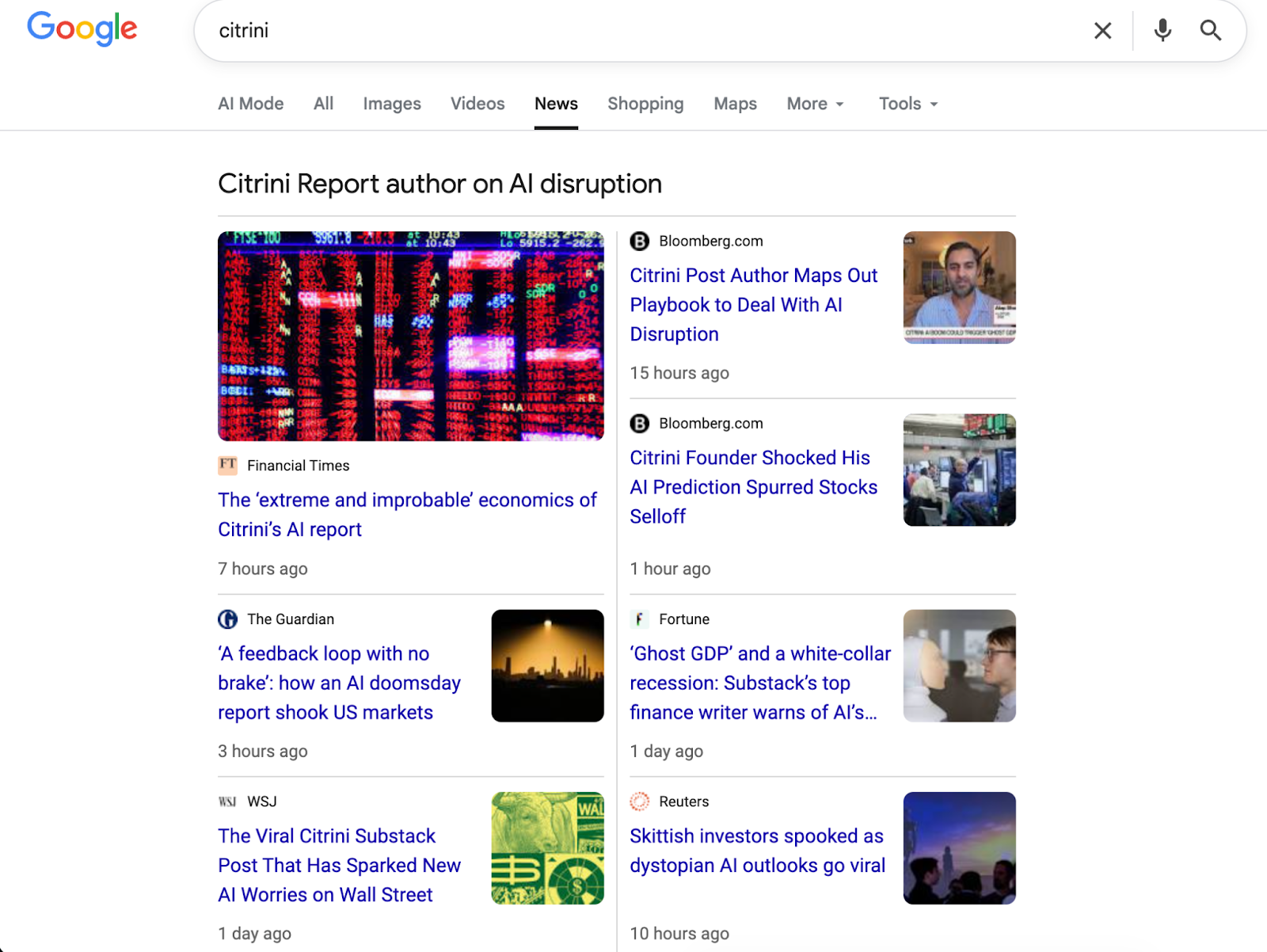
Sure, the firm had some press here and there over the past few years, but it was sporadic at best. Here’s a snapshot of the Google News hits for Citrini before the research report:

But get a load of the coverage after. Just five days after publishing, Citrini is still in the news cycles and earning an increasing number of backlinks from coveted news publications.
And in less than a week, the publication earned a 60% increase in subscriber count from 100,000 to over 160,000:


Not all of these are paid, but conceivably, some of the 63,000 subscribers who flocked to the safety of Citrini’s sage advice decided that $1,000 or even $2,000 per year was worth coughing up.
While it’s not quite the $5,000,000 they raised, surely if 2,000 of those subscribers decided to pay, then the $4,000,000 in annual revenue would be a nice boost to the company's coffers?
While writing an article of this magnitude requires thought and no small amount of effort, coordinating the launch and distribution of the piece requires much more orchestration than simply pressing “publish” on Substack. On the day the report was launched, it was shared across:
Distribution across platforms happened quickly, some of the above were instigated by the Citrini team while others were shared on their behalf. The key note here is that the Citrini team shared the article where it was most relevant: tech blogs and forums. They wrote a 10,000+ word post on how the SaaS industry is going to die and placed it front and center in front of budding SaaS founders – it was a powderkeg that blew in hours.
And let’s not ignore the aspect of timing here. Why Sunday? Markets are closed!
Well, the report spread like wildfire which spooked the markets in Asia (already jittery due to the tariff announcements) enough to send US futures in a downward spiral, ready to greet traders in the morning. And that’s when the mainstream news picked up the story and catapulted Citrini Research from a niche Substack blog to a market-maker.
I’m still bullish on content marketing, even in a world crazed by AI, because this is a classic example of how “marketing” is not just typing words and pressing publish.
There are countless blog posts and rants that never see the light of day because they lack one key ingredient to a successful marketing campaign: distribution. If there’s one lesson to learn here it’s that good marketing is equal parts creating something memorable and being seen. This article checked all the boxes in that it was:
The dangers of the internet here are all too apparent: someone with no financial experience or certifications runs a stock picking newsletter that wreaked havoc on the financial markets and led to a mild panic and dip in the stock market. The difference between this report and the hundreds of doomsday scenarios like it, is this one was seen and shared while the rest are ignored.
I’ve traditionally worked in SEO, where distribution is simply a matter of publishing and requesting Google to index. But let’s not sleep on the power of sharing your content to manufacture interest rather than waiting for the internet to bless you with eyeballs.
Why, every week it could be insights I’ve learned from “the field.”
Fill out the form below to join my weekly newsletter. Every Friday I share stories and practical tips you can apply to your own marketing.

%202.svg)